
Why buy logistics software through GSA?
The GSA Multiple Award Schedule (MAS) exists to take the friction out of federal buying. Instead of running a full open competition for every requirement, agencies can order from vendors whose pricing, terms and compliance have already been negotiated and vetted. For software as specialised as AI-driven logistics orchestration, that pre-vetting saves months.
For contracting officers, the Schedule means faster ordering through GSA Advantage! and eBuy, pre-negotiated ceiling pricing, and confidence that the vendor has met federal contracting standards. For program teams, it means the technology can be in the field while a traditional acquisition would still be in draft.
The Special Item Numbers that matter
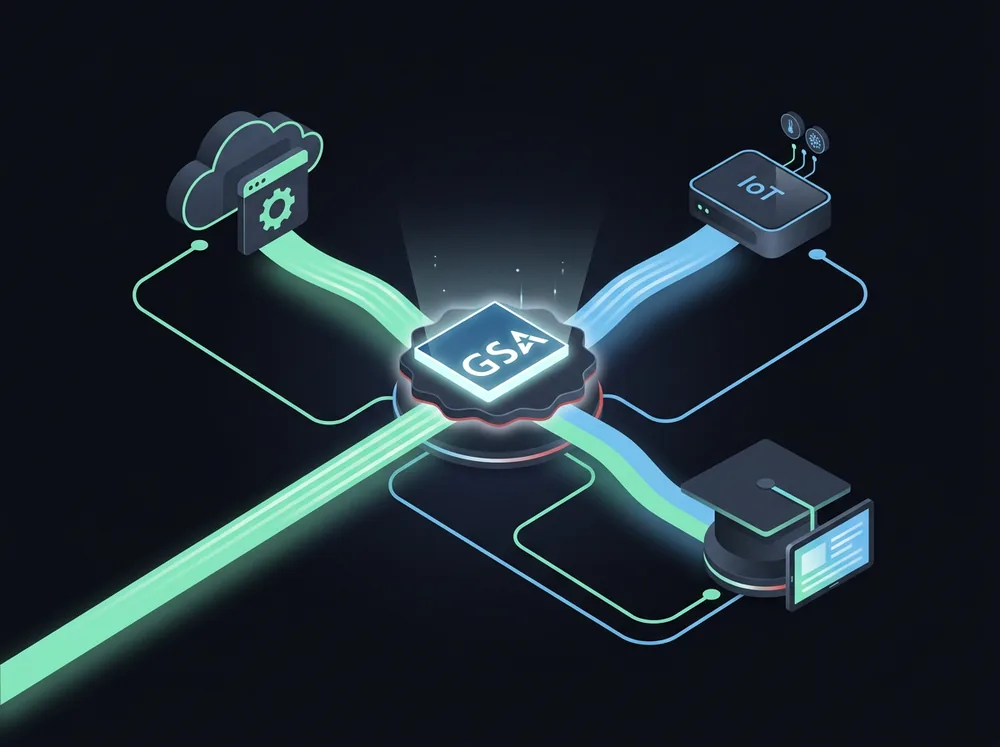
Logistics technology usually spans three categories, and a single Schedule can carry all of them. Praxis Technologies holds three relevant Special Item Numbers (SINs): 518210C for cloud computing and cloud-related IT professional services, 611430TTS for professional and management development training, and 33411 for information-technology hardware and IoT devices.
That combination matters because a real deployment is rarely just software. It is a platform, the mobile applications that feed it, the IoT devices that capture data at the asset, the integration work to connect legacy systems, and the training to get people productive. Buying it all under one vehicle keeps the acquisition — and the accountability — in one place.
Compliance checkpoints to confirm
- Authorization posture — understand the vendor's cloud security posture and any FedRAMP status or roadmap relevant to your data sensitivity.
- Data residency and access — confirm where data is stored and who can access it, especially for controlled or mission data.
- Section 508 accessibility — the software and its training materials should meet federal accessibility requirements.
- Supply-chain and origin requirements — for hardware such as IoT transceivers, confirm the vendor can meet applicable sourcing rules.
How to evaluate an orchestration platform
Visibility is table stakes; the differentiator is whether the platform can act. Ask whether it merely reports exceptions or actually re-plans around them — re-optimising loads, re-routing across carrier networks, and updating stakeholders without manual intervention. Ask how it integrates with the transportation and warehouse systems you already run, and whether it can start as a standalone capability and connect later.
For government fleets specifically, weigh multimodal coverage (land, air, maritime, rail), the strength of the compliance and documentation workflow, and how training is delivered to a distributed workforce.
A practical path to award
The fastest route is usually a scoped pilot: define one measurable problem, request a quotation against the relevant SINs, and order a bounded deployment through eBuy or your contracting officer. Prove the value on real operations, then scale. If you would like to see ORION run against your operation, our team can walk a federal buyer through the options.
See ORION running against your operation
Arrange a demonstration and we'll walk your team through it.
Request a demo →